Teflon Shrink Tubing vs. FEP Shrink Tubing: What Is the Difference?
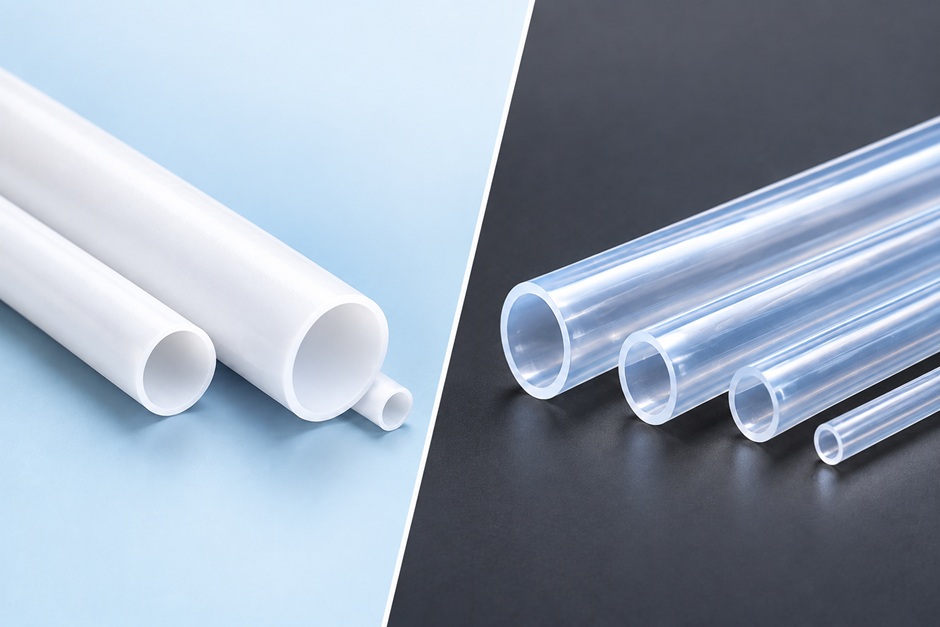
Anyone shopping for heat shrink materials eventually runs into a confusing overlap between Teflon shrink tubing and FEP shrink tubing, and the confusion is understandable since both fall under the same family of fluoropolymers. As a Precision FEP Tubing Manufacturer, we get asked about this distinction often enough that it seemed worth clearing up properly. This blog breaks down what separates the two materials, where each one performs best, and how to decide which fits your application without guessing.
Are Teflon and FEP the Same Thing?
Not quite, though the confusion makes sense. Teflon is a brand name most people associate with PTFE, which stands for polytetrafluoroethylene. FEP, or fluorinated ethylene propylene, is a related compound that shares many of PTFE's chemical properties but behaves differently under heat. PTFE does not melt in a way that allows it to shrink, while FEP does, which is the core reason FEP became the material of choice for heat shrink applications.
Some suppliers market their FEP tubing under the "Teflon Shrink Tubing" label because Teflon has become a catch-all term in the industry, much like how people say "Kleenex" for any tissue. Technically speaking, though, true Teflon-branded shrink tubing and FEP shrink tubing are not identical products.
How Do the Two Materials Differ in Performance?
PTFE holds up to slightly higher temperatures than FEP, often rated a bit above 260 degrees Celsius compared to FEP's ceiling closer to 200 degrees. That gap matters for extreme environments, but most everyday applications never approach either limit, so the difference rarely decides the outcome on its own.
FEP wins out in other areas that matter more often. Its transparency lets technicians see through the tubing to inspect wiring or components underneath, something PTFE cannot offer in shrink form. FEP also processes more easily during manufacturing, which keeps production costs lower and turnaround times shorter for buyers who need tubing on a schedule.
Which One Should You Choose for Your Project?
Picking between the two usually comes down to your specific temperature ceiling and budget. Projects operating well below 200 degrees Celsius rarely benefit from PTFE's extra heat tolerance, and paying a premium for it does not make much sense in those cases. FEP shrink tubing handles the vast majority of medical, electrical, and industrial applications without any performance gap worth worrying about.
Chemical exposure is another factor worth weighing. Both materials resist acids, solvents, and fuels extremely well, so neither has a clear advantage there. Where FEP tends to pull ahead is in applications needing visual inspection or faster shrink cycles during assembly.
Why Manufacturing Quality Changes the Comparison Entirely
A conversation about material properties only tells half the story, because how the tubing gets made affects its real-world performance just as much as its chemistry does. Poorly expanded FEP can develop pinholes or inconsistent wall thickness, and no amount of favorable chemistry fixes that after the fact. Consistent expansion and precise cutting matter enormously here.
Our approach centers on catching those problems before they leave the production floor. The Linear Cut To Length system we developed pairs directly with our expansion machines, letting the cutter separate quality parts from defective ones automatically based on readings taken during expansion. Recovery from pinholes and blowouts happens without manual intervention, which keeps defect rates low across long production runs.
Does the Manufacturer Behind the Tubing Actually Matter?
Buyers sometimes assume all FEP tubing performs the same regardless of who makes it, but that assumption does not hold up under scrutiny. Two rolls of tubing with identical specifications on paper can behave very differently depending on how tightly the manufacturer controlled the expansion process. Wall thickness variation, surface defects, and inconsistent shrink ratios all trace back to production quality rather than the raw material itself.
We built our systems specifically to reduce that variability. Our advanced operating system manages startup and running conditions so operators are not relying on guesswork or manual adjustments throughout a shift. That consistency is exactly what separates tubing that performs reliably from tubing that causes headaches down the line.
Frequently Asked Questions
Can Teflon shrink tubing and FEP tubing be used interchangeably?
In most cases, yes, since many products sold as Teflon shrink tubing are actually FEP. Always confirm the exact material specification before substituting one for another, especially in applications with strict temperature or chemical resistance requirements where the small differences between PTFE and FEP could matter.
What temperature range does FEP shrink tubing handle?
FEP shrink tubing typically performs well up to around 200 degrees Celsius, making it suitable for most electrical, medical, and industrial applications. For projects requiring higher heat tolerance, PTFE-based options may be worth considering, though FEP covers the needs of the large majority of standard use cases.
Why does FEP tubing shrink while PTFE does not?
FEP has a lower melting point and different molecular structure than PTFE, allowing it to be expanded and then heat-shrunk back to its original diameter. PTFE lacks this property, which is why true Teflon shrink products are typically manufactured using FEP rather than pure PTFE material.
How can I verify tubing quality before ordering in bulk?
Ask your supplier about their expansion and inspection process directly. A precision FEP tubing manufacturer should be able to explain how defects like pinholes get caught and removed during production, along with providing sample lots for testing before committing to a large order.
Let's Talk About Your Tubing Needs
Questions about materials rarely have a one-size answer, and yours probably deserves a real conversation rather than another generic spec sheet. We have spent years refining how FEP tubing gets expanded, cut, and inspected, and we are happy to put that experience to work on your project.
Reach out to The Engineering Resource Group, tell us what you are building, and let's figure out the right tubing together.